On this page
- Start with the international principles
- The U.S. approach: identify the human expression
- How U.S. copyright applies to AI-assisted work
- Build a workflow that makes your contribution visible
- 1. Preserve your work before involving AI
- 2. Keep the relevant tool exchanges
- 3. Capture meaningful edits as you make them
- 4. Record selection decisions and the final composition
- 5. Write a short contribution statement
- 6. Deposit dated milestone versions
- A short checklist before sharing the work
- Make your creative contribution traceable
- Sources
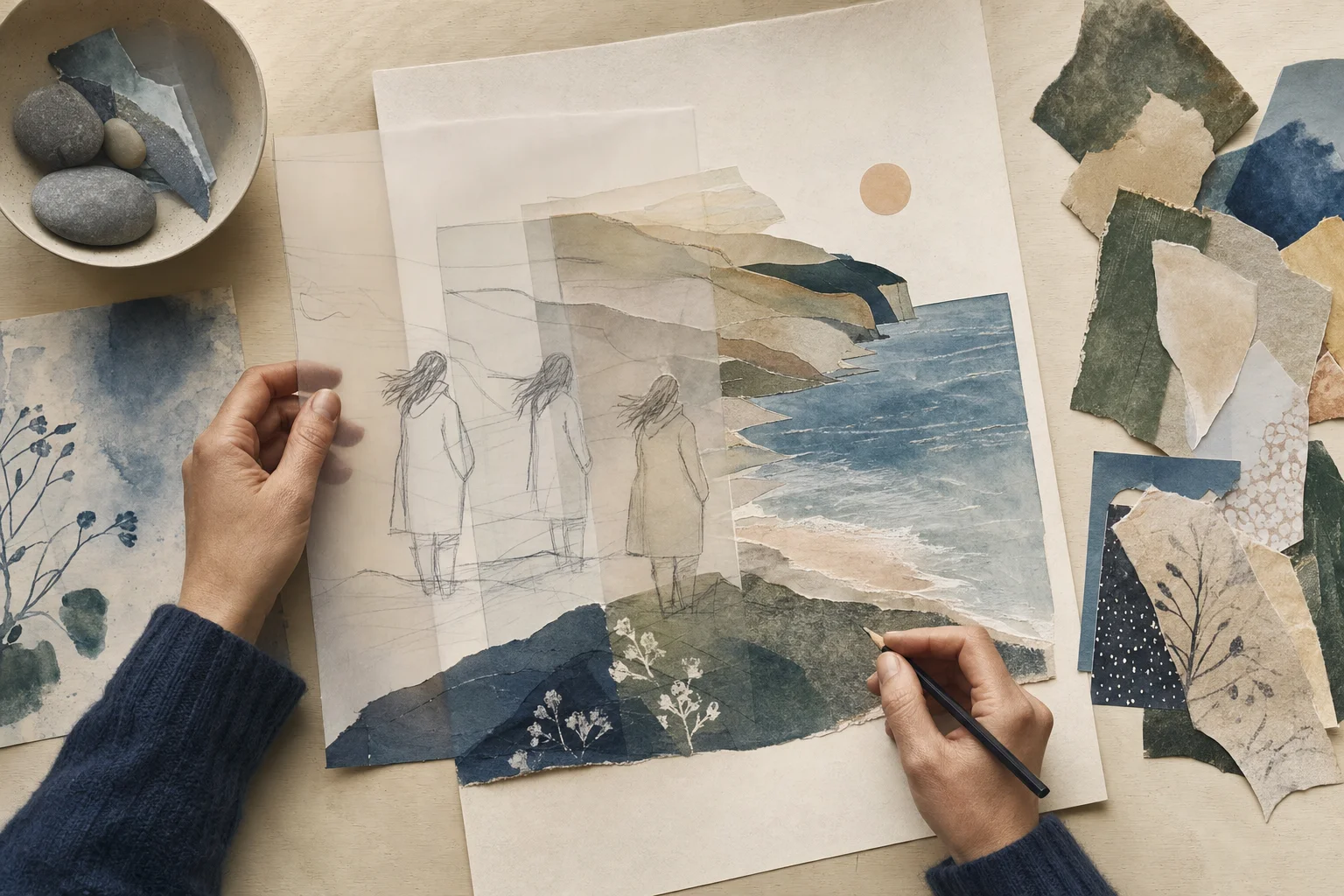
A clear record of your drafts and decisions helps show how your own creative work shaped the final composition.
You finish an illustration, article, or presentation with help from generative AI. The exported file shows the result, but not necessarily the sketch you supplied, the passages you rewrote, or the composition you built yourself. If someone later asks what you created, will your records answer clearly?
The strongest practical approach is to preserve the creative process alongside the finished work. Build a record that distinguishes your original expression, material generated by the tool, and the changes you personally made.
Start with the international principles
The Berne Convention establishes automatic protection: enjoyment and exercise of copyright must not depend on formalities. For qualifying works, copyright arises from creation, not from purchasing a certificate or making a deposit. Countries nevertheless apply their own legal requirements and procedures. (WIPO)
Copyright protects original expression rather than an underlying idea. A broad concept, such as a stormy coastline, is different from the particular drawing or prose expressing it. WIPO also explains that some countries require a work to be recorded in material form. Originality and any applicable fixation requirements therefore remain important when AI enters the workflow. (WIPO)
Keep two questions separate: what contribution qualifies for protection, and what evidence establishes that contribution? Documentation helps address the second question; it cannot replace the legal requirements governing the first.
The U.S. approach: identify the human expression
On January 29, 2025, the U.S. Copyright Office released Part 2 of its artificial intelligence report. It explained that using AI assistance, or including AI-generated material within a larger human-created work, does not automatically prevent copyright protection. Its focus is whether a human determined sufficient expressive elements. This is U.S.-specific guidance, not a promise of identical outcomes elsewhere. (U.S. Copyright Office)
The report identifies potentially protectable human contributions, including original input that remains perceptible in an output, creative modifications, and sufficiently creative selection, coordination, or arrangement. Protection does not thereby extend to underlying AI-generated material. It also concludes that prompts alone, given the generally available technology it examined, do not provide sufficient expressive control. Merely choosing one generated result is different from authoring a creative composition. Assessments remain case-specific. (U.S. Copyright Office report)
For applications to the U.S. Copyright Office, its registration guidance requires disclosure of AI-generated content and an explanation of the human contribution; AI-generated material that is more than de minimis must be excluded from the claim. An evidence deposit with our service is separate from that official registration process. (U.S. Copyright Office guidance)
How U.S. copyright applies to AI-assisted work
In the United States, copyright protects original works of human authorship as soon as they are created and fixed in a tangible form, such as a file, paper, or recording. Registration is not required for copyright to exist. The U.S. Copyright Office requires human authorship, so material generated entirely by AI is not copyrightable; your own creative choices and contributions in an AI-assisted work may be protected. AI-generated material that is more than de minimis must be excluded from the official registration claim.
A dated private deposit can provide evidence of your authorship and of the date your work existed, but it does not replace registration with the U.S. Copyright Office. For a work first published in the United States, you must register it—or have your application refused—before filing an infringement lawsuit. Registering before infringement begins, or within three months of first publication, also matters if you want to seek statutory damages and attorney’s fees.
Build a workflow that makes your contribution visible
1. Preserve your work before involving AI
Create a project folder before your first generation session. Save your original manuscript, sketches, photographs, recordings, or other expressive inputs in their native formats. Keep readable exports alongside them.
Distinguish your own material from licensed references and collaborators’ contributions. For an illustrated poster, for example, preserve your hand-drawn figure separately from reference images and the written brief. Record who created each item. This gives you a starting point against which later versions can be compared.
Save the prompts, uploaded inputs, relevant outputs, and settings used to develop the work. Record the tool and model version where available, together with the session date. Preserve actual files rather than relying exclusively on links to an account.
Treat this as a process record, not a substitute for human authorship. Annotate the tool’s role accurately: generating a background, proposing alternative sentences, or suggesting a color palette. If you cannot recover an earlier exchange, note that gap instead of reconstructing a supposedly exact transcript.
3. Capture meaningful edits as you make them
Save a version before editing generated material, then another after your intervention. Use tracked changes for writing, layers for artwork, and editable timelines for audiovisual projects. Add brief notes explaining what you personally changed.
Be concrete: “Rewrote the closing dialogue and changed the narrator’s perspective” is more informative than “improved the text.” For an image, identify the forms you redrew, elements you repositioned, or textures you painted. Distinguish manual edits from changes produced by another generation request. Do not treat an edit count or percentage as a guarantee of protection.
4. Record selection decisions and the final composition
Preserve representative alternatives and explain why you included, rejected, or combined them. Then document the actual composition: sequence, relationships between elements, placement, pacing, and the integration of your original material.
In the hypothetical poster project, keep the candidate backgrounds, your layout sketches, and the layered file showing how you positioned your drawn figure against selected fragments. Record both the decision and its execution. This is a documentation exercise, not a claim that every preference, rejection, or layout choice necessarily qualifies for copyright.
5. Write a short contribution statement
At each important milestone, add a plain-language account of who did what. Include the project name, version identifier, contributor names, relevant dates, AI-generated components, and your own expressive additions.
Connect each statement to a file or location: a paragraph, layer, scene, or audio segment. Explain where an original input survives in the final result. Avoid claiming the entire work as exclusively human-created if that is inaccurate. If you write the statement retrospectively, distinguish its preparation date from the earlier events it describes.
6. Deposit dated milestone versions
Use our online deposit service to preserve dated versions documenting your original contributions. Useful milestones include your original input, a substantially revised intermediate version, and the final composition. Include the contribution statement and an index identifying the accompanying evidence.
Keep the dated certificate with the exact files deposited, and preserve later revisions as new versions rather than overwriting the record. WIPO recognizes timestamps as a way to establish the state of digital content at a particular time. A deposit can support your account of authorship and chronology, but its date should not be confused with proof of the precise moment creation began. (WIPO)
Depositing AI output does not make otherwise unprotectable material copyrightable. The deposit records evidence; it does not create copyright or expand protection beyond contributions that qualify under applicable law. (WIPO)
A short checklist before sharing the work
- Preserve your original inputs and identify their creators.
- Save relevant prompts, outputs, and tool details.
- Keep before-and-after files showing your edits.
- Record selection decisions and preserve the editable composition.
- Write an accurate, file-specific contribution statement.
- Deposit key versions and retain their certificates together.
Protect your AI-assisted work with a dated deposit that records your creative contributions. Explore CopyrightWeb.com’s deposit options and keep evidence of your authorship and the date your work existed.
Make your creative contribution traceable
You do not need an elaborate diary of every click. You need an organized record connecting your original expression to the finished work. Preserve the inputs, show meaningful interventions, and explain how you constructed the final composition. Then use our deposit service to give those milestone versions a dated evidentiary record. The goal is clear: make it easier to show what you created yourself, without claiming more than the evidence or applicable law supports.
Sources
Article written with the assistance of AI. General information, not legal advice.