On this page
- What commercial records can—and can’t—show
- The principles: rights, authorship, and evidence
- How this works in the United States
- Four commercial records worth keeping
- 1. Invoices, payments, and royalty statements
- 2. Licensing inquiries and negotiations
- 3. Agreements and changes to permissions
- 4. Evidence of actual uses
- Connect everything to the right original
- Use a dated deposit as the identifying reference
- A short commercial-evidence checklist
- Make your work’s commercial history traceable
- Sources
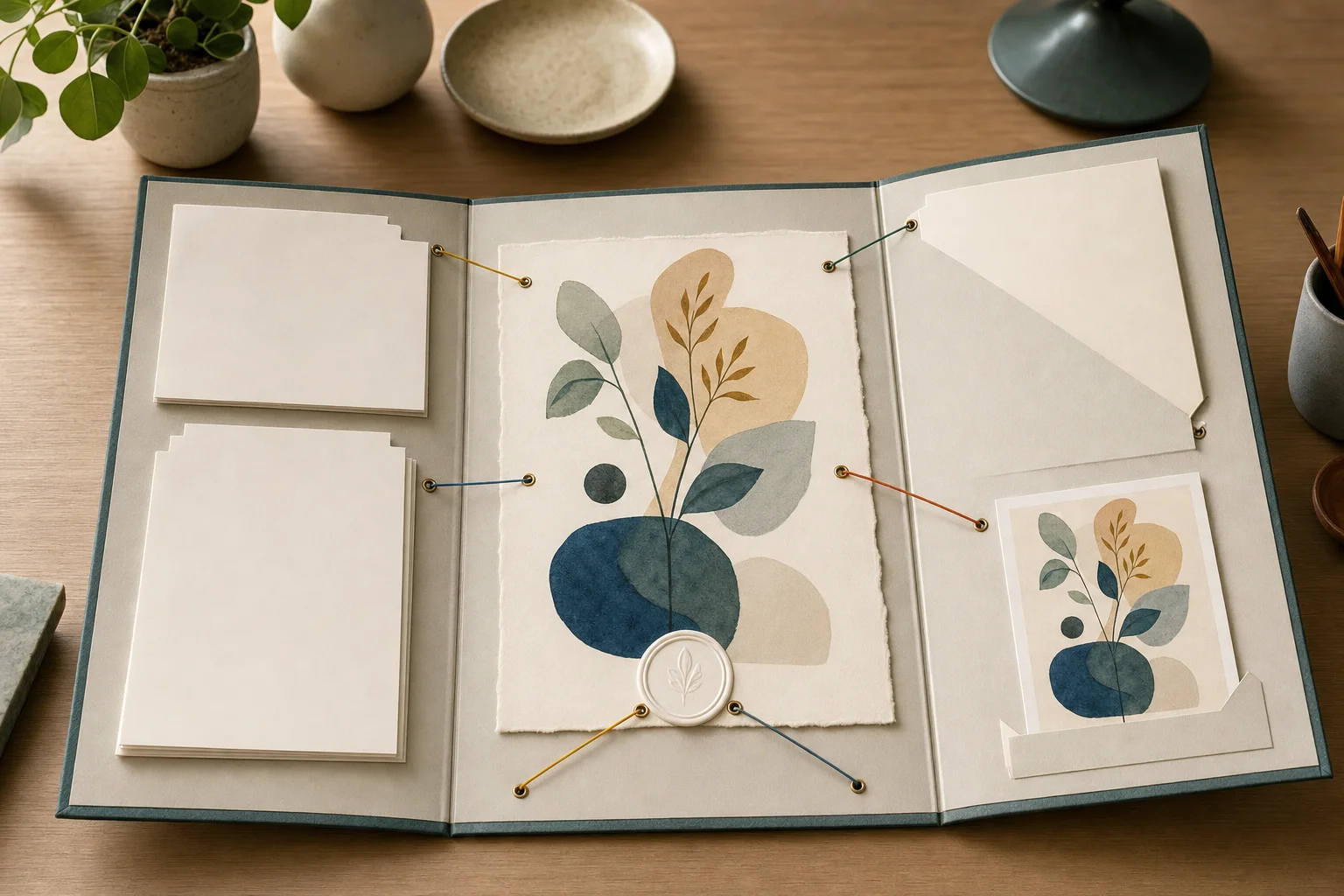
An archival folder links an original botanical artwork to commercial records and a reproduction.
Your original photograph, manuscript, illustration, or recording tells one story: what you created. An inquiry from a publisher, a license you negotiated, and a payment you received tell another: how that work entered the market.
Keep those stories connected. Instead of leaving contracts in one inbox and originals on an unrelated drive, build a record for each work. The goal isn’t to attach an impressive price to every creation. It’s to preserve an accurate account of what was offered, agreed to, paid for, and used.
What commercial records can—and can’t—show
A completed license documents a particular transaction, with its own scope and conditions. A quote records an offer; an inquiry records interest. Keeping these distinctions clear makes your archive more useful for future negotiations and for explaining past dealings.
Document real commercial activity carefully. Don’t treat every inquiry as a completed sale, every unsuccessful negotiation as a proven loss, or every unlicensed use as an established legal violation.
The principles: rights, authorship, and evidence
Under the Berne Convention’s principle of automatic protection, copyright generally arises when a qualifying work is created, without registration formalities, as WIPO explains. A sale isn’t a condition of protection. Copyright protects original expression rather than underlying ideas; WIPO’s overview of copyright protection also explains that some countries require fixation in a material form.
Keep authorship separate from ownership and licensing authority. The creator is generally the first copyright owner, but employment rules and other national exceptions can change that. Preserve documents showing who contributed and who holds the relevant rights. WIPO’s copyright FAQ explains this distinction.
Evidence serves different purposes: drafts support your creation history; agreements document permissions; commercial records document transactions. A dated deposit adds a reference point for the submitted work. It doesn’t create copyright. National rules determine registration’s legal effects and the weight given to particular evidence, as discussed in WIPO’s Creative Expression guide.
How this works in the United States
In the United States, copyright protects an original work as soon as it is created and fixed in a tangible form, such as on paper, in a file, or in a recording. Registration isn’t needed for copyright to exist. A private, time-stamped deposit can provide evidence of your authorship and of the date the work existed, but it doesn’t replace registration with the U.S. Copyright Office.
For a work first published in the United States, you must register it—or have your registration application refused—before filing an infringement lawsuit. For a published work, registering before infringement begins or within three months of first publication is important if you want to be eligible for statutory damages and attorney’s fees.
Four commercial records worth keeping
1. Invoices, payments, and royalty statements
Keep invoices and royalty statements with the related agreement, delivery record, and payment confirmation. Record the work’s identifier and version, customer, currency, amount, and transaction description. Mark whether an invoice is outstanding, paid, canceled, credited, or refunded.
Separate creation fees, expenses, and licensing fees wherever possible. A commission involving extensive production work isn’t automatically a useful comparison for a later license of the finished image. Distinguish a package price from any amount specifically attributed to one work. Don’t present an issued invoice as money you actually received.
2. Licensing inquiries and negotiations
Save the complete inquiry and your response, including attachments. Record the requested work, intended use, territory, duration, media, exclusivity, and proposed fee. Preserve revisions so an opening offer isn’t confused with the final position.
Label the outcome clearly: inquiry only, quote sent, terms under discussion, declined, expired, or agreement concluded. If a prospective customer gives a reason for withdrawing, keep their actual message. Don’t supply a reason they never stated. An inquiry records interest, not guaranteed revenue or proven loss.
3. Agreements and changes to permissions
Keep the signed agreement, schedules identifying the works, amendments, renewals, and termination correspondence. Licensing can be divided by territory, time, language, media, and other categories, so a payment amount without its agreed scope tells an incomplete story. WIPO’s Creative Expression guide explains these licensing distinctions.
Summarize the permissions granted and any express exclusions in your index. For AI-related negotiations, preserve the precise wording about training, datasets, or other uses instead of relying on a label such as “digital rights.” Have unclear terms reviewed under the applicable law rather than assuming permission to publish settles a different use.
4. Evidence of actual uses
Keep examples of authorized uses: a published page, delivered campaign, printed edition, broadcast record, or customer-supplied usage report. For online material, save the page address, capture date, and enough surrounding context to identify the publisher and placement. Keep the underlying file where it’s lawfully available.
If a use appears to go beyond your permission, create a separate incident record. Preserve what you observed and distinguish it from your interpretation. Before alleging infringement, check the agreement, ownership position, and applicable exceptions; WIPO recommends assessing whether a reproduction actually infringes before taking action.
Connect everything to the right original
Give each work a stable internal identifier. Use it in your archive index, quotes, invoices, and agreement schedules wherever practical. Add a version label so drafts, revised editions, and final deliveries remain distinguishable.
For example, when licensing a cropped photograph, link the license to the delivered crop and keep its relationship to the original image. For a collection license, preserve the exact list of included works instead of writing only “portfolio.”
Organize each work’s folder into originals and drafts, authorship and rights documents, inquiries, agreements, financial records, and uses. Keep an index linking these sections and noting important dates. Preserve original messages and attachments, not just a summary you wrote yourself.
Keep backed-up copies and restrict access to confidential contracts and customer information. When sharing an evidence bundle, prepare a redacted copy while preserving the unchanged original. Set retention practices with appropriate legal and accounting advice rather than assuming one period fits every country and document.
Use a dated deposit as the identifying reference
Deposit a clearly identified version through our online service and keep the dated certificate alongside that version. Add the deposit details to your index, then connect the relevant quotes, licenses, invoices, and usage records to the same entry.
The deposit and the commercial records do different jobs. The deposit helps establish which work was submitted and when, supporting your authorship evidence. The commercial records document the dealings associated with it. The certificate doesn’t create the right, independently prove an earlier creation date, set the work’s market value, or guarantee a legal outcome.
Preserve earlier drafts and correspondence to support the broader chronology. When a substantially revised version is ready, consider a further dated deposit and keep its commercial history distinct from the earlier version.
A short commercial-evidence checklist
- Identify the work and exact version consistently.
- Keep originals, drafts, and the dated deposit certificate together.
- Save complete inquiries, quotes, and their outcomes.
- Keep agreements, schedules, and amendments.
- Link invoices to payment evidence and agreed permissions.
- Capture actual uses with dates and context.
- Back up the archive and protect confidential information.
Protect your work with a dated deposit through CopyrightWeb.com. Your deposit provides evidence of authorship and the date your work existed; copyright itself arises when your work is created and fixed in a tangible form.
Make your work’s commercial history traceable
A useful archive connects the creative work to what happened around it, without overstating either. Start with a dated deposit through our service, then maintain the commercial records alongside it. You’ll have a clearer basis for negotiating future permissions and presenting relevant evidence if questions arise.
Sources
Article written with the assistance of AI. General information, not legal advice.