On this page
- The international principles behind the paperwork
- Copyright documentation in the United States
- Private deposits and official registration serve different roles
- Check the requirements of any official filing
- Build identifiable collections in five steps
- 1. Define each batch clearly
- 2. Use stable filenames and matching entries
- 3. Maintain credits and rights information
- 4. Separate creation, publication, and deposit dates
- 5. Preserve the deposited version
- A short collection checklist
- Document the collection, not just the folder
- Sources
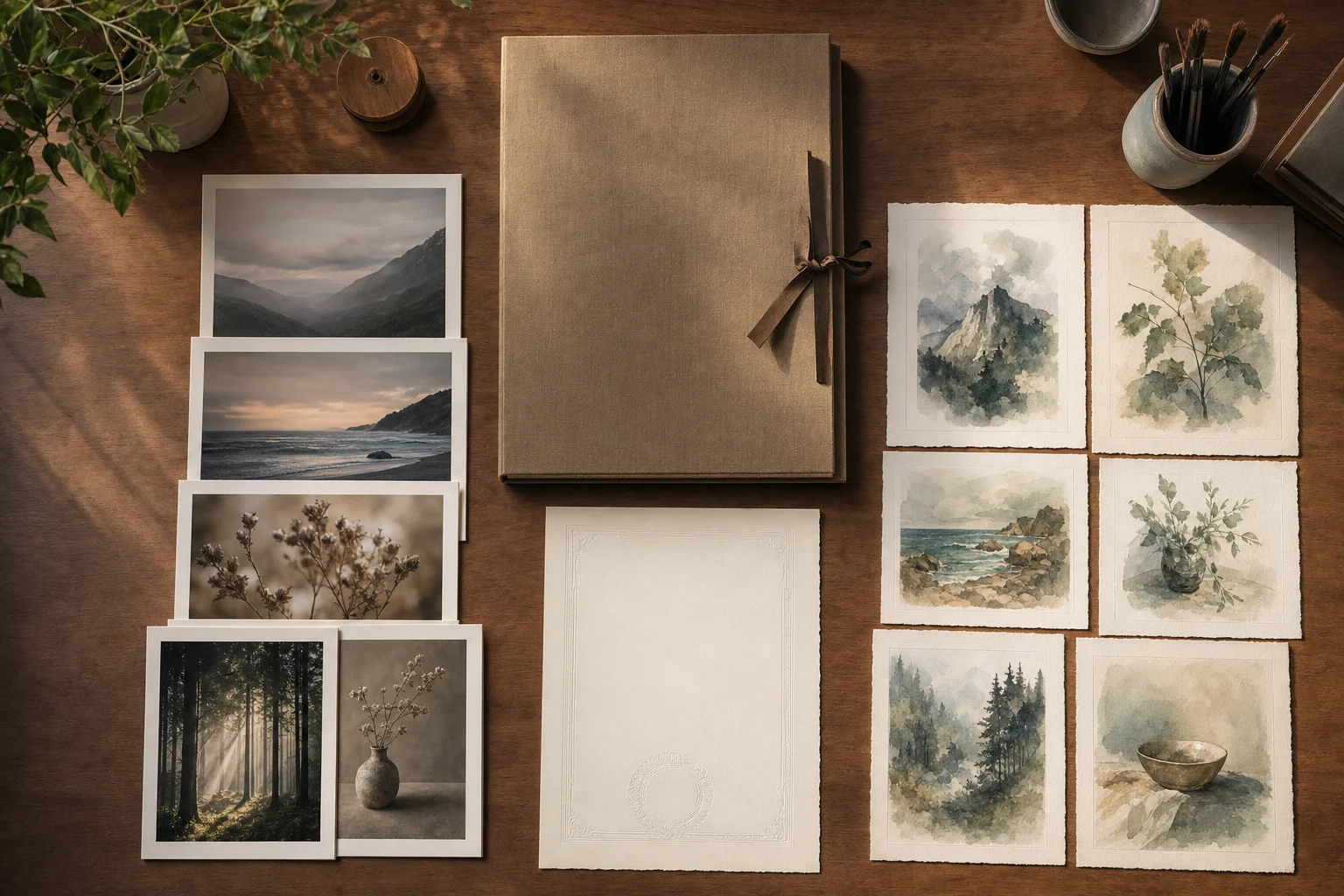
Organize each image collection with an inventory, supporting records, and a dated deposit.
A collection of photographs or illustrations is more than a folder of finished images. It also has a history: who created each work, which version was delivered, when it was completed, and what evidence connects those facts.
The practical challenge is to preserve that history without turning every project into an administrative burden. A clear inventory, consistent filenames, and well-documented deposits provide a manageable starting point.
The international principles behind the paperwork
Copyright and evidence of copyright are different things. Under the Berne Convention framework, copyright protection generally arises automatically, without registration formalities. Protection begins when an eligible work is created, although national requirements differ, including whether expression must be fixed in a material form. A deposit documents a work; it does not create the right. See WIPO’s Berne Convention summary and its guidance on qualifying for protection.
Originality concerns the work’s expression, not merely its underlying idea. Recording a file or obtaining a certificate cannot turn copied material into original authorship. The applicable originality standard must still be satisfied under the relevant national law, as explained in WIPO’s copyright protection guidance.
Authorship and ownership also need separate attention. The original creator is generally the first copyright owner, but exceptions exist, particularly for employment relationships, and rules vary between countries. Do not assume that a public credit answers every ownership question. WIPO’s copyright FAQ explains this distinction.
For documentation, keep two questions separate: what material existed at a particular time, and what connects that material to its creator? Preserve the deposited files alongside drafts and source material supporting authorship and any earlier creation date. WIPO recognizes the importance of evidence of creation; a useful collection record should address both identity and chronology.
Copyright documentation in the United States
In the United States, copyright protects an original work of authorship as soon as it is created and fixed in a tangible form, such as on paper, in a file, or in a recording. You do not need registration for copyright to exist. Keeping evidence of who created the work and when it existed can matter if authorship or timing is disputed.
A private, time-stamped deposit can provide evidence of your authorship and the date your work existed. The party who can prove the earliest date has an advantage in a dispute, but a private deposit does not replace registration with the U.S. Copyright Office. For a work first published in the United States, you generally must register it—or have your application refused—before filing an infringement lawsuit.
Registration timing can also affect whether you can claim statutory damages and attorney’s fees. For those remedies, the work must generally be registered before infringement begins or within three months of first publication. When the requirements are met, statutory damages can reach $150,000 per work for willful infringement. See the U.S. Copyright Office’s general FAQ and Copyright Basics, Circular 1.
Private deposits and official registration serve different roles
Our network’s service lets creators deposit works online and receive a dated certificate for use as evidence of authorship and chronology. Its purpose is evidentiary: to connect identified material and the depositor’s claim to a documented date. It is not registration with a national copyright office.
Keep the certificate with an unchanged copy of the deposited collection. Distinguish the date recorded by the deposit from any earlier creation date supported by sketches, camera originals, working files, or correspondence.
In the United States, official registration has specific procedural consequences. For U.S. works, registration or refusal is generally necessary before an infringement lawsuit can be filed. Registration timing can also affect eligibility for statutory damages and attorney’s fees. A private deposit complements, but does not replace, that official procedure or confer its statutory benefits. See the U.S. Copyright Office’s general FAQ and Copyright Basics, Circular 1.
Check the requirements of any official filing
An archive folder is not automatically an eligible registration group. In the United States, separate procedures cover published and unpublished photographs, each allowing up to 750 photographs subject to conditions, including common authorship and the same copyright claimant. Published photographs in a group must have been published within the same calendar year. The requirements appear in 37 CFR 202.4(h) and (i).
Illustrations should not be treated as photographs simply because both are image files. The U.S. Group Registration of Two-Dimensional Artwork procedure permits 2 to 20 qualifying artworks published within one calendar year, subject to additional conditions. Consult the Copyright Office’s artwork guidance for eligibility details.
Before any official application, check the current instructions for the relevant country and procedure. The workflow below is an organizational recommendation, not a claim that every collection qualifies for group registration.
Build identifiable collections in five steps
1. Define each batch clearly
Choose a coherent boundary: a photographic assignment, an illustration commission, or a completed production period. Give the collection a distinctive title and create a written inventory listing every included work.
For easier review, separate photographs from illustrations and distinguish works involving different creators or rights owners. If one project contains several collections, record how they relate rather than relying on similar folder names.
2. Use stable filenames and matching entries
Adopt a repeatable naming pattern, such as river-study_photo_001_v01.jpg or river-study_illustration_001_v01.png. These are illustrative examples, not prescribed formats. Use an item identifier and version indicator consistently, and avoid ambiguous names such as “final-final.”
Record the exact filename in the collection index. This also has a concrete U.S. filing parallel: the Copyright Office’s published-photograph guidance requires deposited filenames to match their corresponding list entries.
3. Maintain credits and rights information
For each item, record its title, filename, creator’s name, preferred public credit, current rights owner, and relevant contract reference. Use separate fields for the creative contribution and the ownership information so later changes remain traceable.
For collaborative projects, describe each person’s contribution. Keep relevant agreements and permissions for incorporated third-party material with the project records, rather than treating the deposit as a substitute for documenting those permissions.
4. Separate creation, publication, and deposit dates
Maintain distinct fields for completion, first publication where relevant, and deposit. Record the basis for an earlier creation date, such as a working file, dated draft, or documented delivery. If a date is uncertain, describe that uncertainty rather than presenting an estimate as verified.
Keep a note of where and how the work was first released, together with supporting records. If an official application asks about publication status, use that procedure’s instructions rather than assuming that every upload, delivery, or display has the same legal meaning.
5. Preserve the deposited version
Keep camera originals, layered illustration files, sketches, and relevant correspondence alongside the finished exports. Before depositing, check that every listed item is present, opens correctly, and corresponds to the version described in the index.
After using our deposit service, retain the certificate with an unchanged copy of the submitted collection and its index. Document substantial revisions as new versions, and consider depositing those versions separately. Keep backup copies so the collection’s earlier history remains available.
A short collection checklist
- Give the batch a distinctive title and defined scope.
- Match every filename to one inventory entry.
- Record creators, credits, and rights owners separately.
- Distinguish creation, publication, and deposit dates.
- Preserve source files and relevant agreements.
- Keep the deposited version, index, and certificate together.
- Check current official filing requirements where relevant.
You can document your photo collection with CopyrightWeb.com and receive a dated certificate as evidence of authorship and the date your work existed. Explore our copyright deposit options to help protect your work with clear, organized records.
Document the collection, not just the folder
Good documentation should make a collection easier to identify and its history easier to explain. Use our network’s online deposit service to document your next collection, then retain its dated certificate with your supporting records. You will be building a clearer account of authorship and chronology while keeping any separate official registration requirements in view.
Sources
Article written with the assistance of AI. General information, not legal advice.