On this page
- Copyright, authorship, and evidence are different questions
- Why notices and identifying information matter
- Copyright in the United States
- An ISBN helps identify an edition—not every file
- Build a version-by-version evidence archive
- Protect file integrity
- Separate identification from proof of training
- A short checklist for writers
- Deposit milestones to support your chronology
- Make the edition question answerable
- Sources
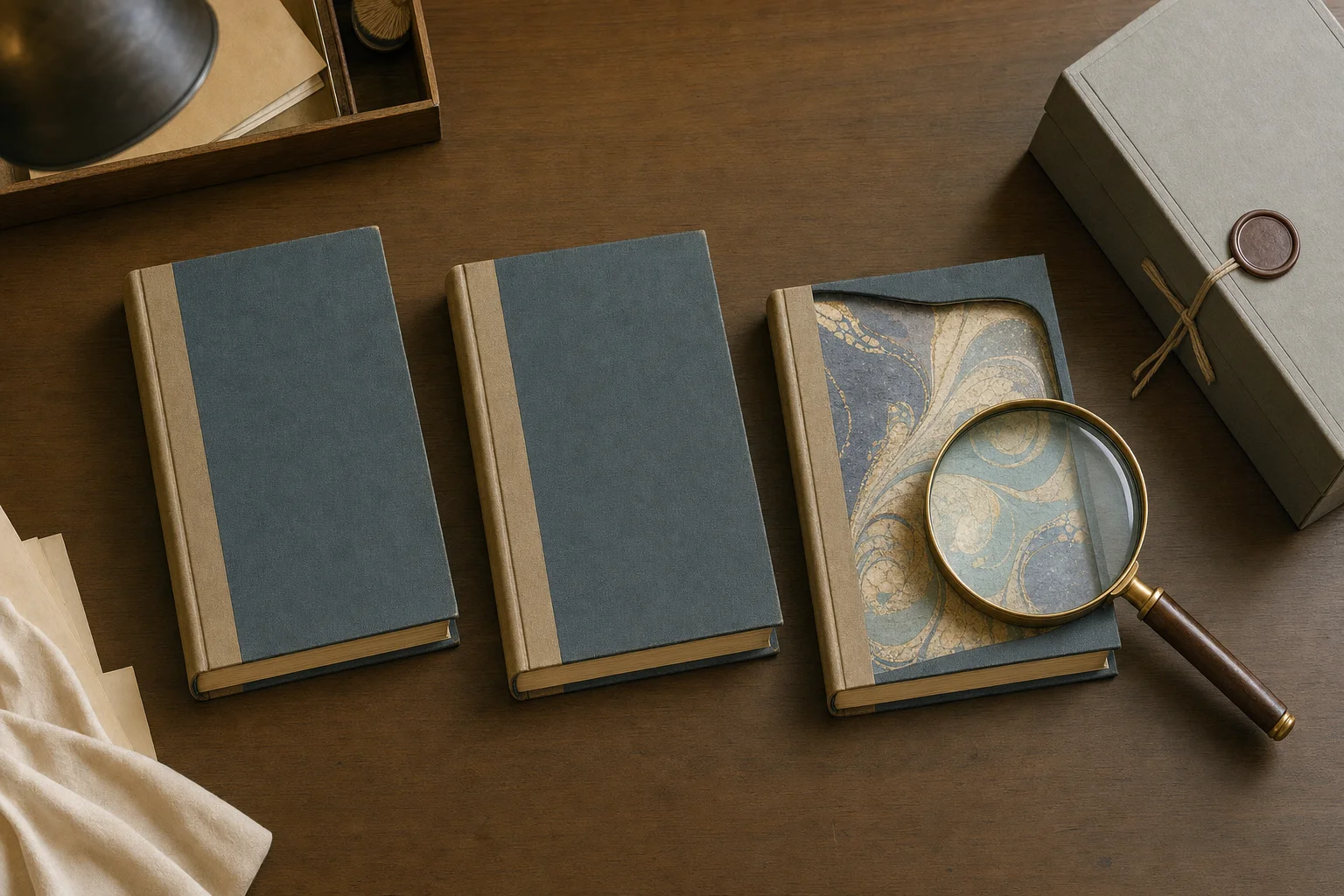
A version-by-version archive can help distinguish book editions and document when each one existed.
If someone alleged that your book had been used to train an AI model, could you identify the exact text involved? Not simply the title, but the submitted manuscript, advance review copy, first published edition, or revised ebook?
That is a useful question to ask before a dispute arises. The practical goal is a version-by-version archive that connects each important text to its identifiers, publication history, and dated evidence.
Copyright, authorship, and evidence are different questions
The international starting point is automatic protection. Under the Berne Convention framework, particularly Articles 2(2) and 5(2), copyright protection generally does not depend on registration or a copyright notice. Protection arises when an eligible work is created, subject to applicable national requirements, including any fixation requirement. A deposit records evidence; it does not create copyright.
Copyright protects original expression, not the underlying idea. Originality concerns the expression you independently create, although the precise threshold varies between legal systems. WIPO explains these basic protection requirements.
Authorship identifies the creator, while ownership of economic rights can depend on contracts, employment rules, and national law, as WIPO’s copyright FAQ explains. Preserve evidence of your writing process alongside agreements with publishers, collaborators, and translators. These records address related but distinct questions: who created the text, who holds relevant rights, and which version existed when.
In the United States, section 1202 of the Copyright Act defines copyright-management information, or CMI, to include specified information identifying a work, its author or copyright owner, copyright notices, and certain identifying numbers or links. Its removal provisions require more than showing that information is missing: statutory conditions include unauthorized conduct and knowledge requirements connected to infringement. Other countries have their own rules.
For recordkeeping, preserve notices and identifying information exactly as supplied with each version. A later comparison should distinguish what the source contained, what the questioned material contains, and what remains unknown.
Copyright in the United States
In the United States, copyright protects an original work as soon as it is created and fixed in a tangible form, such as on paper, in a file, or in a recording. You do not need to register the work for copyright to exist. But if your work was first published in the United States, you must register it—or have your application refused—before filing an infringement lawsuit.
A private, time-stamped deposit can provide evidence of your authorship and of the date the deposited version existed. In a dispute, the party who can prove the earliest date has an advantage, and a dated record kept by a trusted third party can help support that date. A deposit does not replace registration with the U.S. Copyright Office, which you still need before suing over a U.S. work.
An ISBN helps identify an edition—not every file
The International ISBN Agency’s assignment guidance requires separate ISBNs for different formats and language editions, and a new ISBN for substantial textual changes. An ISBN therefore helps distinguish publishing products. It is not a unique fingerprint for every manuscript or every digital file associated with that product.
Do not stop at an ISBN match. Compare the title page, publisher, language, edition statement, format, and actual text. Ask which distinctive passages or corrections separate the versions.
Consider a hypothetical novel whose revised edition adds an epilogue. Finding that epilogue in a questioned copy would help narrow the version inquiry. Finding only a paragraph shared by both editions would not distinguish them. This illustrates version comparison, not proof that either edition was used for AI training.
Build a version-by-version evidence archive
Give each significant version its own folder and archive identifier. Keep earlier versions intact rather than replacing them with the latest file. Use this structure:
- Preserve the text. Save the native writing file and a readable export at major milestones: completed draft, submission manuscript, accepted manuscript, corrected proofs, publication files, and substantial revisions. Label advance review copies separately.
- Create a version record. Record the title and subtitle, author name or pseudonym, language, publisher or imprint, format, edition statement, and relevant ISBN. For an unpublished manuscript, use your own archive identifier without implying it is an official publishing number.
- Describe the changes. Keep a short comparison note identifying additions, deletions, and corrected passages. Preserve tracked changes and editorial correspondence where available. Distinguish substantive revisions from formatting-only exports.
- Preserve the accompanying information. Save covers, title and copyright pages, acknowledgments, permissions statements, and embedded metadata. Keep the actual publication package, not merely a newly exported manuscript that resembles it.
- Connect records to events. Retain submission emails with attachments, proof approvals, publisher delivery confirmations, publication announcements, and catalog records. Record what each document supports: submission, approval, delivery, or public availability.
Keep dates distinct. Record a drafting date as a drafting date, a publication date as a publication date, and a deposit date as a deposit date. When reconstructing an earlier event, identify the supporting record rather than presenting your recollection as independently verified.
Protect file integrity
Maintain protected originals and conduct comparisons on working copies. A cryptographic hash can help check whether a file remains byte-for-byte unchanged. NIST’s digital-evidence preservation guidance, section 3.2, recommends hashing digital evidence and securely preserving the resulting values separately. A hash alone does not identify the author or establish when the writing occurred.
Separate identification from proof of training
When reviewing suspected evidence, keep separate questions: Which work is identified? Which version does the material match? What connects that material to acquisition, processing, or an actual training run?
Treat a title match, catalog entry, or matching passage as a lead to evaluate, not an automatic answer to every question. If recording chatbot behavior, preserve the complete prompt and response, access date, and displayed model details. Note whether your prompt supplied any of the supposedly reproduced text.
Before making public accusations or sending a legal demand, ask a qualified adviser to assess the evidence, applicable law, licenses, and exceptions. Identifying a version and establishing unlawful use are separate tasks. WIPO’s FAQ describes how authorization requirements and exceptions depend on the applicable legal framework.
A short checklist for writers
- Keep each important manuscript milestone and published edition.
- Link identifiers to the correct language, format, and version.
- Preserve notices, metadata, and publication pages.
- Retain correspondence and publication records with their attachments.
- Document differences between versions.
- Keep deposit certificates connected to the exact deposited files.
Deposit milestones to support your chronology
Use our online deposit service for important manuscript milestones, not only the finished book. Consider depositing the completed submission manuscript, the publication version, and each substantial revision. Retain the dated certificate alongside the corresponding file and version record.
A dated deposit adds evidence supporting your authorship claim and the existence of the deposited version by that date. It does not independently verify an earlier claimed creation date, establish that an AI developer obtained the file, or prove copying. Its role is a documented point in a broader chronology, supported by drafts, correspondence, and publication records. WIPO’s guidance on proof of creation and timestamps explains the importance of documenting content at a particular time.
Protect your manuscript milestones with a dated deposit through CopyrightWeb.com’s online deposit service. Your certificate can support your record of authorship and the date a specific version existed; it does not replace U.S. Copyright Office registration.
Make the edition question answerable
You may not be able to identify an exact edition from the available material. Nevertheless, a careful archive lets you explain what matches, what differs, and what remains uncertain. Preserve versions now, deposit meaningful milestones, and keep chronology separate from proof of use. That makes your evidence clearer without claiming more than it establishes.
Sources
Article written with the assistance of AI. General information, not legal advice.