On this page
- The international principles: protection and proof
- Copyright does not begin with a deposit
- Authorship and ownership need separate attention
- Dated records serve an evidentiary purpose
- Copyright evidence in the United States
- Build the file in five connected steps
- 1. Preserve the original and its development
- 2. Connect contributors with the relevant rights
- 3. Distinguish creation, publication, and deposit dates
- 4. Capture suspected misuse in context
- 5. Document cross-border facts without guessing
- Where our dated certificate fits
- Turn the record into a considered response
- A short file-quality checklist
- The takeaway: make your authorship traceable
- Sources
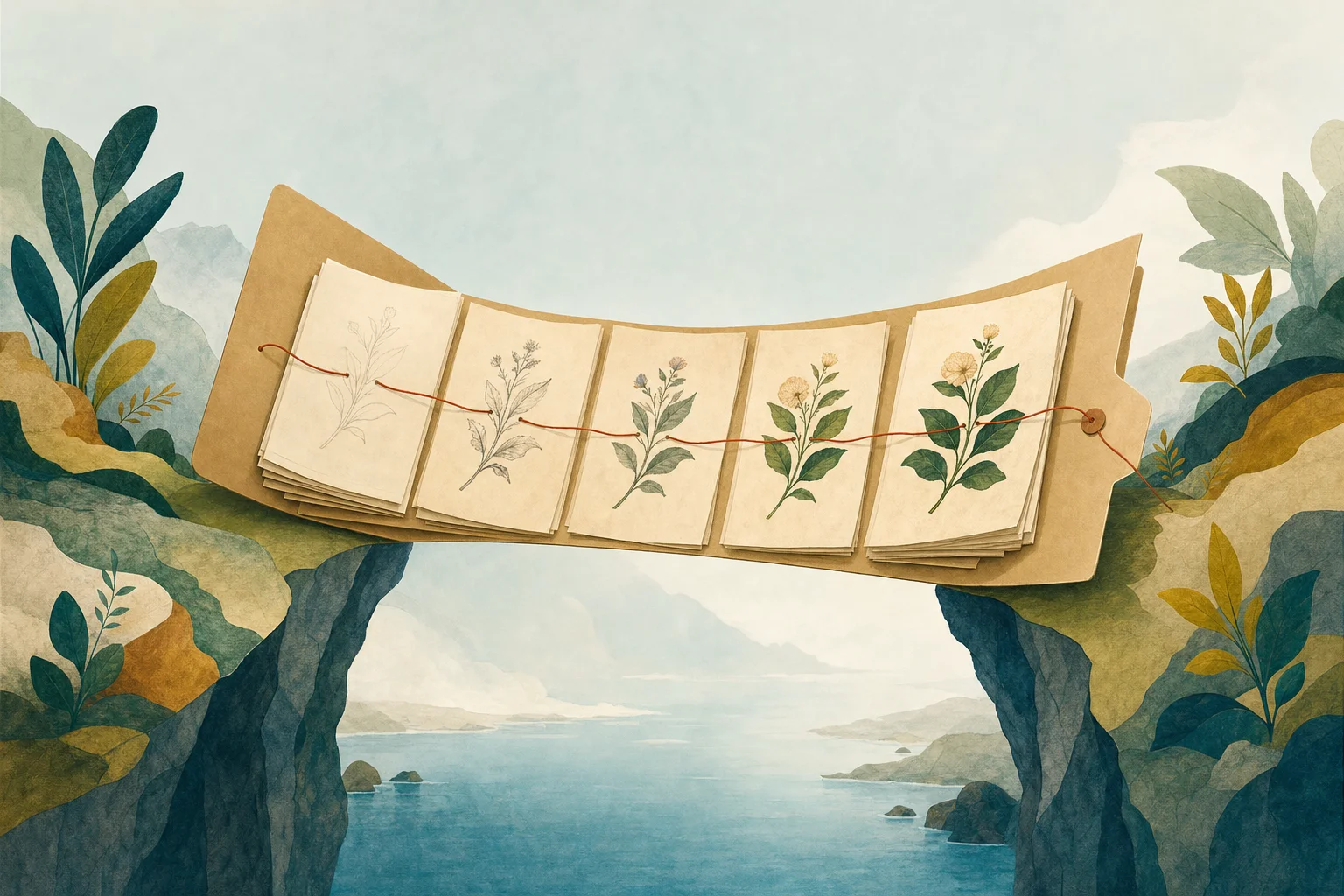
A connected record of creative versions can help make a work’s development easier to trace.
Your photograph appears on an overseas website. A client questions who owns a design. An online response closely resembles a passage you wrote. Before deciding what to do, prepare a record that explains your work’s origin and the use you have observed.
Our recommended approach is one organized evidence file connecting the original work, its development, contributors, agreements, and dates. Add a dated deposit certificate and records of suspected misuse. The aim is not a pile of screenshots, but a documented account that someone unfamiliar with your project can follow.
The international principles: protection and proof
Copyright does not begin with a deposit
The Berne Convention establishes national treatment, automatic protection, and independence of protection. Broadly, qualifying works from one member country receive the protection another member grants its own nationals, subject to the Convention’s provisions. Protection under this framework must not depend on registration formalities. These principles are explained in WIPO’s Berne Convention summary.
Copyright arises when a qualifying original work is created, subject to applicable national requirements, including fixation where required. Originality concerns expression, not ownership of an underlying idea; the precise test requires local analysis. A deposit documents material and a claim concerning it: it does not create copyright or make an unprotectable idea protectable. See WIPO’s guidance on qualifying works.
Authorship and ownership need separate attention
The original creator is generally the first copyright owner, but national laws provide exceptions, including different arrangements for employment. Do not assume that the uploader, client, employer, and author necessarily hold the same rights. WIPO’s copyright FAQ explains these ownership differences and the need to check the relevant national rules.
Dated records serve an evidentiary purpose
Discussing non-mandatory registration systems permitted by national laws, the European Commission’s IP Helpdesk explains that they may be useful when proceedings require evidence of possession and creation on a particular date. That guidance concerns those registration systems; it is not an endorsement of our network or a determination of our certificates’ legal effects.
Copyright evidence in the United States
In the United States, copyright protects original works of authorship as soon as they are created and fixed in a tangible form, such as on paper, in a file, or in a recording. Registration is not required for copyright to exist. Keeping records that show your authorship and when your work existed can help you explain its origin and chronology.
A private, time-stamped filing can provide evidence of your authorship and the date your work existed, but it does not replace registration with the U.S. Copyright Office. You must register a U.S. work, or have a registration application refused, before filing an infringement lawsuit over it.
Build the file in five connected steps
Use one folder for each work or clearly defined collection. Give important versions consistent identifiers, and keep a short index explaining what each document records. Treat the following as an organizational workflow, not a substitute for jurisdiction-specific evidence requirements.
1. Preserve the original and its development
Keep the native file alongside a convenient viewing copy. Preserve relevant drafts, raw photographs, sketches, recordings, research notes, or version histories. Keep working copies separate from the originals you intend to preserve.
Identify exactly which version was delivered, published, or deposited. For example, retain both an early illustration and its revised commercial version rather than relying on the latest file alone. Add a brief description of your creative contribution and identify any third-party material incorporated with permission.
2. Connect contributors with the relevant rights
Record who contributed each element and retain supporting correspondence. Gather employment documents, contributor agreements, assignments, and licenses for legal review. Describe each person’s role without assuming that a payment or file transfer settles ownership.
For permissions you grant, record the authorized material, uses, territory, duration, and any exclusivity provisions. Keep the signed agreement with the version supplied. Flag missing documents or unclear terms so they can be addressed before you rely on them.
3. Distinguish creation, publication, and deposit dates
Maintain a chronology separating drafts, completion, delivery, first publication, revisions, and deposit. Link each entry to supporting material, such as a message, delivery receipt, or publication record. Record time zones where available.
Keep the exact deposited file with its dated certificate. If you later revise the work, preserve the earlier version and consider depositing the significant revision separately. Describe the chronology accurately: a deposit date is a reference point for the deposited version, not automatic verification of an earlier claimed creation date.
4. Capture suspected misuse in context
Record the full web address, capture date, relevant account, and surrounding page. Preserve an untouched capture separately from an annotated comparison. Identify the particular passages, images, or other elements you believe correspond to your original.
For an AI response, retain the complete prompt, response, session context, and date, together with any displayed product or model identifier. Describe what you observed rather than treating a similar output as proof of a particular training source. Preserve materials you can lawfully access without bypassing access controls.
5. Document cross-border facts without guessing
Record verifiable information about the parties, publication arrangements, contracts, and locations of observed uses. Preserve relevant website terms and licensing correspondence. Mark unknown information as unknown rather than inferring server location from a domain name.
Prepare a short factual overview for a qualified lawyer: who created the work, who claims the relevant rights, what use was observed, when, and where. Ask which additional records or preservation methods are appropriate before sending demands or starting proceedings.
Where our dated certificate fits
CopyrightWeb’s online deposit service lets you deposit a work and receive a dated certificate. Retain it alongside the exact deposited version, drafts, and authorship records. Together, these materials can support your account of the work’s origin and chronology.
The certificate contributes evidence; it does not create the right. It is not an official national registration carrying statutory effects, conclusive proof of authorship, or a guarantee of a legal outcome. Its evidentiary weight depends on the applicable rules and circumstances. Use it as a documented reference point within the wider file.
Turn the record into a considered response
Before alleging infringement, check ownership, permissions, and applicable exceptions. WIPO recommends assessing whether a reproduction actually infringes copyright before taking action; national limitations and exceptions can permit some uses without individual permission. Its copyright FAQ outlines these considerations.
Keep observations separate from legal conclusions. Ask local counsel to assess the appropriate court, applicable law, deadlines, and available remedies. Meanwhile, preserve the evidence before requesting removal of the material.
A short file-quality checklist
- Can another person locate each item mentioned in your chronology?
- Are untouched records separate from edited comparisons?
- Are missing documents and uncertain facts clearly flagged?
- Is a secure backup available to the appropriate people?
Protect your work with a dated deposit from CopyrightWeb, and keep the certificate with the exact version you deposited. Explore our copyright deposit options to get started.
The takeaway: make your authorship traceable
Build the record while your project is developing, not only after a dispute begins. Deposit your originals through CopyrightWeb, retain the dated certificate, and connect it with your supporting records. A well-organized file gives you a clearer basis for explaining your authorship, managing permissions, and seeking advice when your work crosses borders.
Sources
Article written with the assistance of AI. General information, not legal advice.